Here’s what you need to know from this blog post:
- Image SEO is about more than just adding pictures; it involves careful image optimisation.
- High-quality, relevant images create a better user experience, which search engines reward.
- Optimising file names, alt text, and file size can directly impact your search results.
- Original images often provide more SEO value than generic stock photos.
- Proper image placement and compression are key to improving page speed and engagement.
Have you ever wondered if adding pictures to your blog post can boost your website’s SEO? It’s a great question. Visuals make your content more engaging, but their impact goes much deeper. The right images, when optimised correctly, can signal to a search engine that your page is valuable and relevant. This blog post will show you how to use images to improve your search rankings and provide a better experience for your visitors.
So, does adding more pictures to a blog post actually help improve SEO? The short answer is yes, but it’s not just about quantity. The relationship between images and SEO is all about quality and relevance. Search engines want to provide users with the best possible results, and that includes a great user experience.
Visual content plays a huge part in that experience. Good image SEO helps search engines understand what your content is about, making it easier for them to rank your page. This boosts your overall SEO performance and enables you to connect with your audience.
Search engines can’t “see” images; they rely on file names and alt text for context. Descriptive file names chocolate-chip-cookie-recipe.jpg help your images appear in relevant searches, driving traffic to your site. Similarly, clear alt text benefits both search engines and users with screen readers. Well-optimised photos can boost your website’s search rankings.
Visual content does more than enhance appearance; it grabs attention and makes blog posts easier to read. Images break up text, making content more digestible and boosting user engagement. Engaged visitors stay longer, lowering bounce rates and signalling value to search engines.
Compelling visuals are also highly shareable. Infographics or striking photos encourage social shares, increasing visibility and driving more traffic through effective image SEO.
Adding more pictures can have a direct, positive impact on your SEO performance, but there’s a catch. Simply dropping a dozen random photos into a post won’t do the trick. The key is to use relevant, optimised images that enhance your content and improve user engagement.
The frequency of your images matters because it can break up long sections of text and keep readers scrolling. This improved experience can lead to better search results. Let’s explore how to strike the right balance between quantity and quality.
When it comes to image SEO, quality will always trump quantity. One high-quality, relevant image is far more valuable than five generic, low-quality ones. A search engine prioritises content that provides a great user experience, and blurry or irrelevant images do the opposite.
So, how many images should you use? There’s no magic number. Instead of focusing on a specific count, focus on making your pictures count. Each image should serve a purpose, whether it’s to illustrate a point, break up text, or showcase a product. The goal is to add value, not just fill space.
Here’s what to prioritise for better image SEO:
- Relevance: Does the image directly relate to the surrounding text?
- Image Quality: Is the picture clear, sharp, and professional-looking?
- Purpose: Does the image help explain your content or take up space?
Have you ever clicked on an article, saw a massive wall of text, and immediately clicked away? Images can prevent that. Image frequency —how often you place visuals in your content- plays a big role in keeping readers on your page. This is tied to a metric called dwell time.
Dwell time is the amount of time a user spends on your page before returning to the search results. A longer dwell time tells search engines that your page is a good match for the user’s query. Well-placed visual content encourages users to stick around and read more.
Breaking up your text with interesting images creates a better reading experience. Following best practices for image placement keeps users engaged from top to bottom. This simple strategy can significantly improve your user experience and, in turn, your SEO.
The debate between original and stock photos is common in SEO. While stock photos are convenient, an original image often carries more weight with search engines and users. Original photos are unique to your brand, which can help you stand out in a crowded digital space.
Using your own images adds authenticity and credibility to your website. This can lead to greater user trust and potentially higher search rankings. Let’s look at why unique images have an edge and whether stock photos are ever a good idea.
Unique images can give your SEO performance a real boost. When Google Search crawls your site and finds a blog image it has never seen before, it views your content as more original and valuable. This is because unique visuals suggest you’ve put in extra effort to create high-quality content.
This originality helps you stand out from competitors who might be using the same popular stock photos. A unique image can make your content more memorable and shareable, leading to more engagement and better rankings over time.
Here’s a simple comparison of unique images versus stock photos:
Feature | Unique Images | Stock Photos |
Authenticity | High | Low |
Uniqueness | High | Low |
SEO Impact | Stronger | Weaker |
User Trust | Builds trust | Can feel generic |
Are stock images bad for SEO? Not necessarily. Google’s experts say using them as decoration is fine and won’t hurt performance. However, if an image is central, like a product photo, a stock image can make your site look generic and weaken your brand.
Original images almost always improve rankings more than stock photos, since they help you stand out. If you must use stock photos, choose high-quality, relevant ones, but remember their limitations.
Effective image optimisation is about more than just choosing pretty pictures. To get the most value from SEO, you need to follow a few key best practices. This includes selecting relevant images, using descriptive file names, and managing your file size to ensure fast loading speeds.
These steps help search engines understand your content and improve your site’s visibility. Ready to learn how to do it right? Let’s explore the essential techniques for optimising your images like a pro.
The first step in image optimisation is choosing the right picture. Always select high-quality images that are directly related to your content. For instance, if your blog post is about travel destinations in Italy, use stunning photos of Rome or Florence, not a generic beach picture.
Relevance is crucial for SEO purposes. When your images match your text, it reinforces your page’s topic for search engines and improves the user experience. People are more likely to engage with content that has strong, supportive visuals.
High-quality images also build credibility. A sharp, professional photo makes your brand look more trustworthy than a blurry or pixelated one. Optimised images affect your rankings by signalling to search engines that you provide valuable, user-friendly content.
Never upload image files with generic names like DCIM_5678.jpg. A search engine uses the file name to understand the image’s context. Using descriptive file names is a simple but powerful step to optimise your images.
For example, if you have a photo of a red running shoe, name the file red-running-shoe.png. This tells Google Images exactly what the picture is about, increasing your chances of ranking for related searches. It’s a small change that makes a big difference.
You also need to choose the right file formats. Different formats have different strengths.
- JPEG: Best for photographs. It offers a good balance between quality and file size.
- PNG: Ideal for graphics with text or transparent backgrounds. It maintains sharp quality.
- WebP: A modern format that offers excellent compression and quality, leading to faster load times.
Beyond file names and formats, there are a few other essential elements for great image SEO. Things like alt text, title tags, and image captions provide extra context for search engines and users. Getting these details right can seriously improve your SEO performance.
These elements also make your website more accessible and user-friendly. Let’s look at why alt text is so important and how to use title tags and captions for maximum impact properly.
So, is it important to add alt text? Absolutely. Alt text, or alternative text, is a short written description of an image. Its primary purpose is accessibility. Screen readers use alt text to describe images to visually impaired users, ensuring everyone can access your content.
But alt text is also critical for SEO. Since a search engine can’t see your image, it reads the alt text to understand what the photo shows. A descriptive alt text helps your image rank in Google Image Search and reinforces the topic of your page.
When writing alt text, be concise and descriptive. Instead of “dog,” write “golden retriever catching a frisbee in a park.” This level of detail helps both users and search engines, making it a win-win for accessibility and ranking.
In addition to alt tags, use title tags and image captions. Title tags appear when users hover over an image and, while less important for SEO than alt text, they enhance user experience. Image captions below photos provide context and are often read as people scan a page. Good captions explain the image and relate it to your content, helping both users and search engines understand its relevance and strengthening your SEO.
Image size and page speed are directly linked. Large, unoptimized images can significantly slow your website’s load times. This creates a poor user experience and can hurt your rankings, as page speed is a key factor for Core Web Vitals and overall SEO.
Proper compression helps you reduce image file sizes without sacrificing quality. By making your images smaller, you can ensure your pages load quickly for everyone. Let’s explore how to manage image sizes and compress them effectively.
Large images slow down page load times and can significantly reduce conversions—even a one-second delay matters. Mobile users, especially those with slow connections, may leave your site if images are too large, which can increase bounce rates and harm your search rankings.
Why avoid large images?
- They slow down loading speeds.
- They use more data, affecting mobile users.
- They cause layout shifts, lowering your Core Web Vitals score.
The solution to large image files is compression. Compressing images reduces their file size, helping your pages load faster. The best part? You can do it without making your high-quality photos look blurry or pixelated. This is one of the best practices for SEO purposes.
There are many tools available for compressing images. Some, like Photoshop, give you manual control over the quality settings. Others, like TinyPNG or WordPress plugins like Smush, automatically create smaller file sizes for you. The goal is to find the right balance between size and quality.
By consistently compressing your images before uploading them, you ensure a fast, smooth experience for your visitors. This simple step can dramatically improve your page speed, which is a significant factor in how search engines rank your site.
Where you place a blog image on your page matters; good image placement isn’t just about aesthetics; it’s about context. Placing an image near relevant surrounding text helps search engines understand its purpose. This applies to blog posts, product pages, and any other pages on your site.
Strategic placement can improve user experience and boost your SEO performance. Let’s look at where you should place images in your content and why spreading them out is often better than clustering them.
In a blog post, start with a compelling image “above the fold” that’s immediately visible to capture attention. Place images logically next to related text, such as after each step in a process. Use visuals to support your content and enhance user experience—images and text together make your page more valuable for readers and search engines.
Large clusters of images in blog posts can be overwhelming and confusing. Instead, spread visuals throughout your article to break up text, maintain engagement, and boost SEO.
Benefits include:
- Improved readability and flow
- Sustained reader engagement
- Each image reinforces a specific point
Static images are great, but interactive visuals like diagrams and infographics can take your content to the next level. These visuals are highly engaging and excellent at explaining complex information in a simple, visual way.
Because they are so helpful, infographics and diagrams are often widely shared on social media, which can drive significant traffic and backlinks to your site. This can have a very positive effect on your search results. Let’s explore how to use them to improve your visibility.
Infographics, diagrams, and charts are most effective for presenting data or complex ideas. People process visual information much faster than text, so a well-designed chart can make your point more clearly and quickly than a long paragraph.
This improved understanding leads to better SEO performance. When users find your content exceptionally helpful, they are more likely to share it and link back to it. These backlinks are a powerful ranking signal for Google Search.
Here’s when to use these visuals for maximum impact:
- To summarise key statistics or research findings.
- To explain a complex process or workflow.
- To compare different products or options.
Just like regular pictures, interactive images need proper optimisation to be found by search engines. This starts with the basics: a descriptive file name and detailed alt text that explains what the infographic or diagram is about.
To take it a step further, you can use structured data. Schema markup for images provides search engines with detailed information about your visual content. You can specify the creator, license information, and a caption, which helps your image show up in rich results.
By optimising your interactive images, you ensure that search engines can understand and index them correctly. This increases their visibility in image search and helps drive more organic traffic back to your website. It’s a crucial step you shouldn’t skip.
Even with the best intentions, it’s easy to make a few common image SEO mistakes. Things like using the same image repeatedly or neglecting file naming and metadata can hold back your SEO performance. These errors can confuse Google Search and weaken your content’s impact.
By being aware of these pitfalls, you can avoid them and make sure your image strategy is as effective as possible. Let’s look at a couple of common mistakes and how to fix them.
Will using the same image across multiple posts hurt your SEO? It can. While it might not result in a direct penalty, it creates a repetitive and unoriginal user experience. Search engines prioritise fresh, unique content, including your visuals.
Using the same stock images on every blog post makes your site look generic. It’s much better to use unique images for each piece of content. This signals to search engines that you’re creating high-value, original material. It also increases your chances of being featured in places like Google Discover.
Here’s why you should avoid reusing images:
- It creates a poor user experience.
- It makes your content feel less unique and authoritative.
- It misses an opportunity to rank new, unique images in search.
Poor file naming is a huge missed opportunity for SEO. When you upload image files with names like image1.png, you’re giving the search engine zero context. A search engine relies on file names and metadata to understand what your images are about.
Missing metadata, especially alt text, is another significant risk. Without alt text, visually impaired users can’t understand your images, and search engines have a harder time indexing them correctly. This can negatively impact your overall SEO performance.
Taking a few extra seconds to give your images descriptive names and complete their metadata is one of the easiest and most effective steps for image optimisation. Don’t let this simple task hold your content back from its full potential.
In summary, incorporating more images into your website can significantly enhance your SEO efforts. Visual content not only engages visitors but also helps search engines better understand your pages. By following best practices like using relevant images, optimising alt text, and compressing file sizes, you can improve your site’s load speed and visibility. Remember, the right mix of quality and quantity matters—unique images often perform better than stock photos. So, get creative with your visuals! If you’re unsure where to start or need assistance, don’t hesitate to reach out for a free consultation. Your website’s success could be just a picture away!
There’s no magic number. Instead of counting images, focus on quality and purpose. Add relevant photos where they help illustrate a point or break up text. Good image SEO is about enhancing the content, so use as many as needed to create an excellent experience for your reader and the search engine.
Yes, absolutely! Proper image optimisation is key to appearing in Google Image Search results. When you use descriptive file names and detailed alt text, you tell the search engine what your images are about. This helps them show up for relevant queries, driving more traffic to your site.
Yes, original images typically provide a bigger boost to your SEO performance than stock photos. A unique original image signals authenticity and quality to search engines, helping you stand out. While stock photos are okay for decoration, they don’t offer the same unique value for your image SEO.
Leverage the insights from our blog to refine your marketing funnel. Apply these proven strategies from the Lebanese market to boost your business success.
Here’s a quick look at why YouTube is more than just a video site.
- YouTube is widely considered a social media platform due to its many social features.
- Users can create profiles, subscribe to channels, and interact through likes and comments.
- Content creators build communities and engage with their audience, a key part of social media.
- Features like live streams and community posts increase social engagement.
- While it focuses on video content, its core functions align with other social media platforms.
Have you ever wondered, “Is YouTube social media?” It’s a fair question. We all know it as the go-to place for video content, almost like a massive video search engine. But with features like comments, subscriptions, and creator channels, the line gets blurry. YouTube has changed how we watch and share videos. So, does that make it a social media platform? Let’s take a closer look and figure it out together.
Before we can label YouTube, we need to know what a social platform really is. At their core, social media sites are online spaces where people connect. They let you share content, connect with others, and build communities.
The modern social media landscape is diverse, but most platforms share a few key traits. We’ll explore what defines a social media site, look at some popular examples, and break down their primary functions.
So, what makes a website a social media platform? It comes down to a few key social elements. First, they let you create a personal profile. This is your space to share a bit about yourself. Think of it as your online identity.
Next, a social platform is built for sharing. You can post updates, photos, or videos for others to see. This content sharing is what sparks conversation and connection. Without it, a site is just a one-way street.
Finally, social engagement is essential. This means you can interact with other people’s content through likes, comments, and shares. These actions turn a passive experience into an active one. Any website that includes these features can be considered a social media tool for connecting people.
You use them every day, but what makes each one different? The digital world is full of social media platforms, and each has its own flavour. Understanding them helps us see where YouTube fits in.
Some popular social media networks have become household names. They are a core part of many marketing strategies and daily life. Here are a few examples:
- Facebook: Great for connecting with friends and family.
- Instagram: Focuses on visual social media content, such as photos and short videos.
- Twitter (X): Built for real-time news and short, text-based updates.
- TikTok: Known for short, creative, and often viral videos.
Each of these platforms allows users to create, share, and interact. They prove that social media isn’t a one-size-fits-all concept.
While social media sites may look different, they share the same core goals: bringing people together online.
Their primary function is social networking—connecting users with friends, family, or those with similar interests. This forms the foundation of any online community.
Other key functions include:
- Content Creation: Allowing users to make and share posts.
- Social Interaction: Enabling likes, comments, and conversations.
- Community Engagement: Building a sense of community around shared interests.
Together, these features create an interactive experience.
At its heart, YouTube is a website where you can watch and share video content. It was launched in 2005 and quickly became the world’s biggest video library. Because you can find almost anything on it, it also acts as a powerful search engine.
But it’s more than just a place to watch videos. YouTube is a hybrid platform that blends entertainment with social interaction. We’ll explore its history, unique features, and how it delivers content to its users.
- YouTube launched in 2005, created by three former PayPal employees seeking an easy way to share videos online. Its rapid growth attracted Google, which acquired YouTube in 2006 and invested in global expansion. Now a Google subsidiary, YouTube is the world’s second-most visited website and a key force in online culture.
While YouTube is all about video, it has features that make it much more than a streaming service. These tools help creators connect with their audiences in new ways. They also make the platform an excellent spot for digital marketing.
You can find tons of product reviews and tutorials, making it a powerful search engine for shoppers. But the interactive features are what truly set it apart.
Here are a few key features:
- YouTube Shorts: Short, vertical videos designed for quick, engaging content.
- Community Posts: Updates with text, polls, and images that keep subscribers engaged between video uploads.
- Live Streams: Real-time broadcasts where creators can interact directly with viewers. These tools are all about fostering a community.
YouTube uses an innovative algorithm that analyses your watch history and subscriptions to recommend videos, keeping you engaged with relevant content.
The algorithm also helps creators reach the right audience by evaluating video titles, descriptions, and viewer engagement. Optimising your content improves its visibility.
Businesses use this system to run targeted YouTube ads and reach interested viewers. Common ad types include:
Ad Type | Description |
Skippable In-Stream | Play before/during videos; skippable after 5 seconds. |
Bumper Ads | Unskippable 6-second ads; ideal for brand awareness. |
Display Ads | Appear beside featured videos and above suggestions. |
So, what makes YouTube feel like social media? It’s all about the social features. These are the tools that allow you to do more than just watch. They let you participate, share your opinion, and connect with others.
These interactive features are what build communities around channels and topics. From the comment section to live chats, YouTube has many community features that encourage interaction. Let’s explore how these tools work.
YouTube’s social side goes even further with community posts and live streams. The Community tab allows creators to post text updates, polls, images, and GIFs. It’s like a mini-blog right on their channel, offering another way to maintain social engagement between video uploads.
Live interactions are at the heart of social media, and YouTube does this well. During live streams, viewers can talk to the creator and each other in real time through live chat. This direct interaction makes the experience feel personal and exciting.
These interactive features are key to building a strong community.
- Community Posts: Share updates beyond videos.
- Live Chats: Engage in real-time conversations.
- Polls: Get direct feedback from your audience.
- Super Chat: Highlight your message during a live stream.
It’s clear YouTube has social features, but how does it stack up against traditional social media platforms? Some people argue it’s different because its primary focus is video. Platforms like Facebook and Twitter are built around shorter, mixed-media updates.
This comparison helps us understand YouTube’s unique place in the digital world. Is it a true social network, or something else entirely? Let’s look at the differences and similarities in community building and content style.
While all social media platforms connect people, each has unique strengths.
YouTube excels at long-form video, making it ideal for tutorials, reviews, and in-depth entertainment—great for video marketing and brand awareness.
Facebook is versatile, combining text, photos, videos, and groups for broad interaction.
Instagram focuses on visuals, from photos to short videos via Reels.
Here’s a quick comparison:
Feature | YouTube | ||
Primary Content | Long-form video | Mixed media | Photos & short video |
Main Goal | Entertainment, education | Connecting with others | Sharing moments & visuals |
Interaction Style | Comments, likes, subs | Likes, comments, shares | Likes, comments, DMs |
So, why do some people hesitate to call YouTube social media? The main reason is its content format. YouTube is built around polished, long-form videos. This can feel more like watching TV than scrolling through a social feed of quick updates.
Because of this, some see it as a hybrid platform. It’s part search engine, part entertainment hub, and part social network. People often visit with a specific goal, like learning how to do something or watching a review, which is different from casually browsing other social media content.
However, these differences don’t take away its social elements.
- It’s primarily a video-on-demand service.
- Interaction is centred around the video, not personal status updates.
- It fosters a strong sense of community, even if the format is different.
The debate over whether YouTube is social media has good points on both sides. It helps to look at them side by side. The arguments boil down to whether its social features outweigh its primary function as a video host.
The case against it is simple. YouTube is mainly used for watching videos, much like a streaming service. Its powerful search function also makes it feel more like a utility than a social network. People come for content first, and interaction second.
But the arguments for it are stronger.
- For: It allows user-generated content creation and sharing.
- For: It offers robust community features such as comments, likes, and subscriptions.
- For: It enables direct interaction between creators and fans.
- For: It’s a significant platform for social media marketing. Ultimately, its ability to connect people makes it social media.
YouTube is a unique platform that sits at the intersection of video sharing and social media. It offers features like commenting, liking, and subscribing that foster user interaction, making it feel social. Yet, it also stands apart from traditional social media sites in how it prioritises content delivery and user experience. Whether you view YouTube as a social media site or not, there’s no denying its impact on how we connect and share information today. So, what’s your take? Do you see YouTube as just a video platform, or does it fit into the social media category for you? Let us know your thoughts!
Yes, most experts consider YouTube a social media platform. It allows users to create profiles, share content, and interact through likes, comments, and subscriptions. The ability for content creators to build communities through social features like community posts and live streams solidifies its status as social media.
Absolutely. Social engagement is a massive part of the YouTube experience. Viewers can comment, like, and share videos, while content creators can reply, host live chats, and post updates. This two-way social interaction is key to building a community around any successful YouTube channel.
YouTube has evolved from a simple video-sharing site into a cornerstone of the social media landscape. It has added more interactive features, becoming a vital tool for creators to engage with fans and for businesses to reach potential customers. It’s now essential for anyone wanting to use the digital world to its full potential.
Leverage the insights from our blog to refine your marketing funnel. Apply these proven strategies from the Lebanese market to boost your business success.
Here’s what you need to know about Google reviews and SEO.
- Positive Google reviews significantly boost your local SEO and search rankings.
- The quantity, quality, and recency of reviews all impact your online presence.
- Responding to reviews shows Google your business is active, which helps your ranking.
- Reviews act as powerful social proof, building trust with new customers.
- An optimised Google Business Profile is essential for collecting and showcasing reviews.
- Keywords within customer reviews help improve your visibility in local search results.
You have probably wondered if putting effort into Google reviews is worth it for your SEO strategy. Does getting more online reviews actually help you show up higher on Google? The short answer is a big yes. Your reviews are more than just feedback; they are a key part of how Google sees and ranks your business. Let’s break down the reality of how these reviews influence your visibility and what you can do about it.
First, let us cover the basics. Google reviews are simply the ratings and comments that customers leave for businesses on Google. These customer reviews appear directly on your Google Business Profile, in Google Maps, and within search results.
They give potential customers a quick look at what others think about your products or services. Understanding how this system works is the first step to using it for your SEO benefit. We’ll explore the fundamentals, how to set up your profile, and how customers interact with reviews.
Google reviews offer direct customer feedback through star ratings and written experiences, visible on Google Search and Maps. These reviews generate fresh, user-created content that signals your business is active and relevant, something Google’s algorithm favours.
Positive reviews boost your credibility and popularity, helping Google better understand your business and improving your visibility in search results.
Before collecting reviews, set up your Google Business Profile, your digital storefront on Google. Ensure all information is accurate and complete, as an optimised profile attracts reviews and boosts SEO. A well-maintained profile with positive reviews ranks higher in local searches. Keeping your profile active and encouraging reviews strengthens your standing with Google’s algorithm.
Leaving a Google review is simple, which makes online feedback common. Customers can find your business on Google Search or Maps and click “Write a review” to share their rating and comments.
This ease encourages more reviews, boosting your online presence and SEO. Sending review requests generates more customer feedback, giving Google more content to evaluate and increasing your business’s visibility.
Google reviews are crucial for local SEO and directly impact your local search rankings. High ratings and more reviews signal trust to Google, helping your business appear in the “Local Pack” or on Google Maps. Reviews act as key trust signals and boost your rankings. Let’s explore how with real examples.
Google reviews boost local search rankings by building trust—both for potential customers and search engines. Positive reviews act as social proof, with 91% of younger consumers trusting them as much as personal recommendations. Google’s algorithm treats many positive reviews as a signal of credibility, making your business more likely to appear in search results and rank higher locally.
Online reviews directly impact your local search rankings, accounting for over 15% of local business ranking factors. Google confirms that reviews boost “prominence,” a key factor in regional rankings.
More positive reviews and higher ratings signal to Google that your business is popular and trustworthy, boosting your visibility in results like the Google Local Pack. A 5-star rating can raise Local Pack clicks by 25%.
How reviews help local search:
Ranking Factor | How Reviews Help |
Prominence | More reviews show your business is well-known and respected. |
Relevance | Keywords in reviews help match your business to relevant searches. |
Trust | High ratings build credibility with both users and Google. |
A clear review strategy can significantly boost a local business’s search ranking.
For example:
- A Chicago coffee shop asks satisfied customers for reviews. As its Google Maps rating rises, it appears higher in local searches and attracts more customers.
- An Austin plumber sends follow-up emails requesting reviews. Positive feedback on their Google Business Profile increases visibility and leads to more service calls.
- A Miami restaurant highlights positive reviews in marketing. This social proof attracts reservations and signals popularity to Google.
While Google reviews are famous for their impact on local results, their benefits don’t stop there. They are a valuable part of your broader SEO strategy, influencing your overall search engine rankings and online presence. The trust and content they generate can help your business beyond just map searches.
Whether you’re a local shop or an online store, understanding this connection is key. Let’s examine the differences between local and traditional SEO benefits and how reviews play a role across various industries.
Local SEO benefits directly from reviews, as they are a key ranking factor in the Map Pack and signal local prominence to Google.
For traditional SEO, reviews add fresh, keyword-rich content when embedded on your site, helping pages rank for specific terms. Star ratings can appear as rich snippets in search results, boosting visibility and click-through rates. While reviews are essential for local SEO, they also enhance content and trust for traditional SEO.
Absolutely, Google reviews impact rankings for all types of businesses, though their importance can vary. In the hospitality and travel industries, for example, reviews are everything. Travellers rarely book a hotel or choose a restaurant without checking its ratings first.
But the same principle applies to almost any industry. Whether you’re a retailer, plumber, lawyer, or digital agency, your potential customers look for social proof. Positive Google reviews on your business profile can build trust and drive conversions for service-based businesses.
For e-commerce stores, product page reviews can be powerful. While these might not be Google reviews, the principle is the same. Good review management is a universal need. Authentic feedback helps customers make decisions and signals quality to search engines, no matter what you sell.
So, what tangible SEO performance boosts can you expect from a solid review strategy? The influence on your SEO ranking is real, leading to measurable results that can help your business grow.
By actively managing your Google reviews, you can see several key improvements in your business’s visibility and attract more customers from search results. Here are a few boosts you can anticipate:
- Higher Click-Through Rates: Star ratings in search results make your listing stand out, encouraging more people to click. This can lead to a significant increase in organic traffic.
- Improved Local Rankings: Better reviews directly contribute to higher visibility in the Google Local Pack and on Google Maps.
- Increased Trust and Conversions: Positive reviews build credibility, which can persuade more visitors to become customers.
Google’s algorithm evaluates multiple factors to determine the impact of your reviews on search ranking—it’s not just about 5-star ratings.
To optimise your business profile, focus on a balance of star ratings, review quantity, freshness, and quality.
Google values the freshness of reviews in SEO rankings; a recent review holds more weight than one from years ago. New reviews signal to Google that your business is active and relevant, just as customers trust current feedback over outdated ones. Consistently gathering recent reviews keeps your profile fresh, boosts credibility, and helps maintain or improve your search rankings.
Quality and Detail of Review Content
To boost SEO with Google reviews, focus on quality and detail. Brief reviews like “Great service” offer little value. Detailed feedback, such as “The emergency plumbing service was fast and fixed our leaky pipe in under an hour” , naturally includes relevant keywords, helping Google understand your services. Encourage customers to mention specific products or services in their reviews for better search visibility.
Responding to Reviews, Does It Boost SEO?
You might see responding to Google reviews as just good customer service. But does it actually improve your SEO? Yes, it does. Engaging with customer reviews by writing thoughtful review responses is a key part of managing your online reputation and boosting your SEO.
When you reply, you increase activity on your profile and signal to Google that you are an engaged and attentive business owner. This customer engagement sends positive signals that can improve your visibility. Let’s look at how to handle both positive and negative reviews.
Benefits of Replying to Positive Reviews
Replying to positive reviews is an easy way to boost SEO. Beyond politeness, it reinforces good experiences and encourages future engagement.
Thanking customers shows you value their feedback, builds loyalty, and attracts new customers by demonstrating your commitment to satisfaction.
Key SEO benefits:
- Increases Engagement: More activity signals relevance to search engines.
- Builds Relationships: Shows strong customer service, encouraging more positive reviews.
- Adds Content: Replies can include keywords, enhancing your business’s relevance.
Handling Negative Reviews Smartly
Negative reviews happen, but they don’t have to sink your business. How you handle a negative review matters most. And yes, unanswered negative feedback can harm your rankings by lowering your average rating and signalling poor customer service to Google.
The key is to respond quickly and professionally. Acknowledge the customer’s concerns, apologise for their bad experience, and offer to resolve the issue offline. A thoughtful response shows other potential customers scrolling through Google Search that you take customer satisfaction seriously.
This can turn a negative into a positive. It demonstrates that you are committed to making things right, which builds trust. By managing negative feedback effectively, you can mitigate reputational damage and show Google that you are a responsible business.
Building Engagement and Signals for Google
Responding to reviews builds customer engagement and signals activity to Google. Each reply adds fresh content, showing your business is active, something Google’s algorithm rewards.
Active communication boosts SEO by making your business appear more credible and trustworthy in search results, just as social media engagement increases brand visibility.
Treat your Google Business Profile as a dynamic communication platform. Frequent interaction sends positive signals to Google, which can improve your rankings over time.
Best Practices to Leverage Google Reviews for Better SEO
Knowing that reviews are critical is one thing. Actively using them to improve your SEO is another. A proactive approach to review management can transform your online reputation and drive real results for your business.
This means going beyond just waiting for reviews to come in. You need a solid SEO strategy to encourage, manage, and showcase feedback. Here are some of the best practices for leveraging your reviews to their full potential.
Asking for More Reviews from Happy Customers
The easiest way to get more reviews is to ask for them. Satisfied customers are usually happy to share feedback if you make it simple. Regular new reviews boost credibility.
Aim for at least 10–15 reviews as a starting point, then focus on consistently collecting more.
Easy ways to request reviews:
- Send a follow-up email or text after a purchase or service.
- Include a link to your Google review page on receipts or invoices.
- Ask in person after a positive interaction.
Using Review Keywords to Help SEO
A great way to leverage reviews for SEO is by encouraging the use of relevant keywords within them. Quality reviews often contain specific details that help Google understand exactly what your business does.
You can guide this process without being pushy. During your review collection efforts, try asking specific questions. Instead of just “How was your experience?” you could ask, “What did you think of our deep-dish pizza?” or “How was our emergency roof repair service?”
This prompts customers to use the keywords you want to rank for naturally. When you respond to reviews, you can also subtly incorporate these keywords. This reinforces the topics your business profile is associated with, increasing your likelihood of appearing in relevant searches.
Monitoring, Managing, and Showcasing Reviews Efficiently
Effective review management is about more than just collecting and responding. It’s about efficiently monitoring your online reputation and using your positive reviews as marketing assets. This is another excellent way to leverage reviews for better SEO.
Set up alerts so you know immediately when a new review comes in. This allows you to respond quickly and stay on top of your feedback. A consistent review strategy is key to improving your business visibility over time.
Here are some tips for efficient management:
- Use a review management tool to see all your reviews from different platforms in one place.
- Embed a feed of your best reviews directly on your website. This adds valuable, keyword-rich content and builds trust with visitors.
- Share positive reviews on your social media channels to amplify their impact.
Conclusion
In summary, Google Reviews play a vital role in boosting your SEO. They act as trust signals for potential customers and can significantly impact your local search rankings. By actively managing both positive and negative reviews, you not only enhance your online presence but also engage your audience more effectively. Remember to encourage satisfied customers to leave feedback and respond thoughtfully to all reviews. This approach not only shows you care, but it also builds credibility for your brand. If you’re ready to take your business to the next level, get a free consultation to discuss how to optimise your Google Reviews strategy!
3-Frequently Asked Questions
How many Google reviews does my business need for a noticeable SEO impact?
There isn’t a magic number of Google reviews, but aiming for a steady stream is key to your review strategy. A good starting point is 10-15 reviews to establish credibility. After that, focus on consistently getting new reviews to maintain freshness, which positively impacts your local SEO and SEO ranking.
Can negative reviews harm my search rankings?
Yes, a negative review can harm search rankings by lowering your overall star rating. However, the real damage comes from ignoring customer feedback. Prompt, professional review responses can mitigate the damage to your online reputation, showing potential customers and Google that you are committed to resolving issues.
Does Google favour recent reviews over older ones?
Yes, Google heavily favours recent reviews. Freshness and review recency are crucial SEO ranking factors because they signal that your business is currently active and relevant. A steady stream of new feedback on Google Search signals to the algorithm that your business is a timely and trustworthy choice for users.
Leverage the insights from our blog to refine your marketing funnel. Apply these proven strategies from the Lebanese market to boost your business success.
A marketing funnel is a strategic model that outlines the journey a customer takes from initial awareness to final purchase. It is crucial for businesses to understand and optimize each stage to effectively guide potential customers through the buying process. By analyzing each phase, marketers can tailor their strategies to increase engagement, conversions, and customer retention, ultimately driving business growth.- A marketing funnel is a framework that maps the customer journey from initial awareness to making a purchase.
- The three main stages of the funnel are Top of the Funnel (TOFU), Middle of the Funnel (MOFU), and Bottom of the Funnel (BOFU).
- Understanding the marketing funnel helps your marketing strategy by identifying where potential customers drop off.
- Lebanese businesses can use the funnel to tailor marketing campaigns to local consumer behaviors and needs.
- Optimizing each funnel stage with relevant content and offers leads to higher conversions and customer loyalty
The marketing funnel visually outlines the steps a potential customer takes before making a purchase. It helps you understand and influence the customer journey, from broad awareness to buying decisions.
For Lebanese businesses, the funnel provides a structured approach to attracting and nurturing leads, focusing on both engagement and sales. This guide explains how to apply the concept to your operations.
The marketing funnel guides prospects through stages toward conversion, helping teams plan and measure efforts to attract, engage, and convert customers. Popular models include AIDA (Awareness, Interest, Desire, Action) and the three-phase approach, which is commonly referred to as the top, middle, and bottom of the funnel. Each stage serves to move people closer to becoming customers. Regardless of the model, the funnel’s goal is to attract leads, engage them with valuable content, and drive conversions, making it essential for effective marketing strategies.
In Beirut’s competitive market, a marketing funnel is essential for success. It maps the customer journey, clarifies buying stages, and guides efficient budget allocation.
Tracking drop-off points reveals weaknesses and enables data-driven improvements, such as understanding why site visitors don’t sign up for your newsletter.
A targeted funnel ensures that prospects receive timely, relevant messages, thereby boosting engagement and trust. Optimising your funnel systematically converts visitors into customers, driving scalable growth.
A marketing funnel guides the customer journey, but this path is rarely linear. In Lebanon, for example, a consumer might skip awareness entirely and enter consideration after hearing about your brand from a friend.
Understanding these varied entry points is essential. One person may find you through Instagram ads, while another may see you through a Google search.
Your funnel should be flexible to engage customers at any stage. By optimising each step, you create touchpoints that lead to purchase, regardless of where their journey starts.
The marketing funnel is typically broken down into three main stages, each corresponding to a different part of the customer journey. At the top, you have the awareness stage, where people first become aware of your brand. In the middle is the consideration stage, where they evaluate your offerings.
Finally, at the bottom, you have the purchase stage, where the customer makes a final decision. Some models also include post-purchase stages, such as loyalty and advocacy, to focus on customer retention. The following sections will explore what each of these stages means for your business.
The awareness stage (top of funnel) is when Lebanese customers first discover your brand. They know little about your products, so focus on broad brand visibility and lead generation by highlighting the problems you solve.
Effective campaigns attract attention and make a strong first impression. Utilise SEO blog posts that address common questions, run paid ads on popular platforms like Instagram, or partner with Lebanese influencers to introduce your brand and expand your audience.
Once a potential customer moves into the middle of the funnel (MOFU), they have already engaged with your brand in some way. Perhaps they followed you on social media or subscribed to your email list. Now, your goal is to build on that initial interest, earn their trust, and differentiate your brand from competitors.
Your marketing efforts should shift from broad awareness to providing value. This is where you demonstrate your expertise and help your audience understand why your solution is the right one for them. Think of this as building a relationship with your target audience.
Content like detailed blog posts, case studies featuring local businesses, and product comparisons is highly effective here. These materials answer specific questions, solve problems, and guide prospects closer to a decision, making them feel confident in what you offer.
The bottom of the funnel (BOFU) is where prospects are ready to become customers. Your goal is to persuade them to act by addressing their final doubts and making it easy for them to choose your brand.
At this stage, offer free trials or demos, share customer testimonials for social proof, and send targeted emails, such as discounts for abandoned carts, to encourage conversion.
The customer journey doesn’t end at purchase. For Lebanese businesses, repeat customers are key to long-term success. Loyalty and advocacy focus on retention by building lasting relationships that encourage return visits.
Loyalty programs, exclusive discounts, and personalised follow-ups demonstrate your value to customers beyond the initial sale, strengthening brand connection.
Your goal is to turn loyal customers into brand advocates, repeat buyers who recommend your business to others. In Lebanon’s close-knit market, word-of-mouth is vital, making brand advocates a powerful marketing asset.
Thinking about the marketing funnel in abstract terms can be difficult. It’s much easier to understand when you can visualise it. Simple models and templates help break down the marketing funnel stages into actionable steps.
We will explore the popular TOFU, MOFU, BOFU model with examples from local Beirut brands. Additionally, we will provide a sample marketing funnel template that small businesses in Lebanon can adapt to plan their marketing channels and improve the customer experience.
The TOFU, MOFU, and BOFU model divides the marketing funnel into three stages: awareness (TOFU), consideration (MOFU), and conversion (BOFU). Each stage has a specific goal and tactic.
For example, a Beirut coffee shop might:
- TOFU: Share an Instagram video of a new drink to build brand awareness.
- MOFU: Publish a blog on choosing coffee beans to engage interested customers.
- BOFU: Offer a “2-for-1” online deal to encourage customers to make purchases.
This approach guides customers from casual interest to purchase in an organised way.
Sample Marketing Funnel Template for Small Businesses in Lebanon
For small businesses in Lebanon, building a marketing funnel can be simple. Use a basic template to organise each stage, set clear goals, and choose tactics that match your customers’ needs. This enhances the customer experience and enables you to measure success.
Focus on educational content at the top of the funnel and direct offers at the bottom of the funnel. Here’s an easy template to adapt:
| Funnel Stage | Goal | Example Tactic |
|---|---|---|
| Awareness | Attract visitors | Run social media ads targeting your city |
| Consideration | Capture leads & trust | Offer a free guide for email addresses |
| Conversion | Drive purchases | Send limited-time discount codes to your email list |
| Loyalty | Encourage repeats | Create a loyalty program (e.g., buy 5, get one free) |
Theory is one thing, but seeing the marketing funnel in action makes it click. The Lebanese market is filled with businesses, both big and small, that effectively utilise funnel strategies in their marketing campaigns, even if they don’t refer to it as such.
By examining these local examples, you can gain a clearer understanding of how to apply these concepts to your own brand. We’ll explore how Lebanese retailers build brand awareness, how Beirut service providers generate leads, and how e-commerce sites drive sales at each stage of the funnel.
Brand Awareness Campaigns by Lebanese Retailers
At the awareness stage, the goal is to increase your visibility. Many Lebanese retailers excel in this area by utilising a strategic blend of digital and traditional marketing channels. Consider a well-known fashion boutique in Beirut. They might launch a new collection by collaborating with popular local fashion influencers on Instagram.
These influencers post photos wearing the new items, instantly exposing the brand to thousands of their followers. The retailer might also run visually striking ads on Facebook and Instagram, targeting users based on interests like “fashion” and “shopping” within Lebanon.
These top-of-funnel activities aren’t designed to make an immediate sale. Instead, they plant a seed. The objective is to make sure that when someone in their target audience thinks about buying a new dress, their brand is one of the first that comes to mind.
Lead Generation Tactics from Beirut Service Providers
For service providers in Beirut, such as digital marketing agencies or fitness studios, the middle of the funnel is all about lead generation. At this stage of the customer journey, prospective customers are aware of their issue and actively seeking solutions. The goal is to capture their contact information and begin a conversation.
A common marketing tactic is offering a valuable resource in exchange for an email address. For example, a Beirut-based gym might provide a free “7-Day Home Workout Plan” as a downloadable PDF on its website. Interested individuals provide their email addresses to receive the guide and become leads.
Similarly, a business consultant could host a free webinar on “How to Grow Your Small Business in Lebanon.” By providing tangible value upfront, these service providers build trust and credibility, nurturing prospective customers and moving them further down the funnel.
Conversion Techniques Used by Local E-Commerce Businesses
When a customer reaches the purchase stage of the conversion funnel, local e-commerce businesses need to make the final push. The goal is to turn interest into a sale. A notable example is a Lebanese online store that specialises in selling artisanal foods. After a visitor adds items to their cart but doesn’t check out, the store can send an automated email.
This email might say, “Looks like you forgot something!” and include a 10% discount code to encourage them to complete the purchase. Another effective technique used on the landing page or during checkout is highlighting “Free Delivery in Beirut.” This removes a common barrier to purchase and can significantly boost the conversion rate.
These bottom-of-funnel strategies focus on creating a sense of urgency and making the buying process as seamless as possible. They provide the customer with the final nudge needed to click “Buy Now.”
Building a marketing funnel is just the beginning. To get the best results, you need to optimise every stage continuously. Optimisation involves analysing data to understand what works and what doesn’t, then making strategic changes to improve performance.
This means you should regularly review your marketing strategy, from the ads that attract visitors to the landing page that converts them. By employing tactics such as A/B testing and tailoring content across various marketing channels, you can significantly enhance your success rate at each stage of the marketing funnel.
To boost performance at the awareness stage, you need to maximise your visibility where your audience spends their time. In Lebanon, this means a strong focus on social media and search engine optimisation (SEO). Your goal is to make it easy for people to discover your brand.
Don’t just post randomly; create a strategy. Research what your target audience is searching for and what kind of content they engage with. This ensures your efforts are reaching the right people and building meaningful brand awareness.
Here are a few optimisation strategies for the top of the funnel:
- Local SEO: Optimise your website with Arabic and English keywords relevant to your business in Lebanon (e.g., “best restaurants in Beirut”).
- Engaging Social Content: Create shareable content, such as short videos, polls, and carousels, on platforms like Instagram and TikTok that resonate with local culture.
- Collaborations: Partner with local influencers or complementary businesses to cross-promote and expand your reach to a new audience.
Increasing Engagement with Content Tailored for Beirut Audiences
In the middle of the funnel, engagement is everything. To keep your audience engaged, your content marketing must be tailored specifically to their needs. Generic content won’t build the trust needed to move someone from a prospect to a buyer. Think about the unique challenges and interests of your target audience in Beirut.
Are you a financial advisor? Create a guide on navigating Lebanon’s economic climate. Are you a wellness brand? Host a webinar on managing stress, a topic many in Beirut can relate to. This level of personalisation shows you understand their world.
By creating content that speaks directly to their needs, you position your brand as a helpful resource, not just a seller. This builds a stronger relationship and makes your audience more receptive to your offers when they reach the bottom of the funnel.
Improving Conversions through Landing Page and Offer Optimisation
At the bottom of the funnel, small changes can lead to significant results. This is where landing page and offer optimisation become critical. Your landing page should have one clear goal: to get the conversion. Remove any unnecessary distractions, use a strong call-to-action (CTA), and ensure the page loads quickly, especially on mobile devices.
Don’t assume you know what offer will work best. Use A/B testing to experiment. For example, test a “15% Off” offer against a “Free Shipping” offer to see which one generates a higher conversion rate. You might be surprised by the results.
Continuously refining these elements of your conversion funnel ensures you are not losing potential customers at the final step. A seamless, compelling experience at the bottom of the funnel is key to maximising your sales and return on investment.
Retention Tactics Used by Successful Lebanese Companies
Successful Lebanese companies understand that acquiring a new customer is only the beginning. The real value lies in retention. By implementing clever tactics, they foster customer loyalty and turn buyers into enthusiastic brand advocates. A simple yet effective tactic is a points-based loyalty program.
For instance, a local cafe in Beirut might offer a loyalty card where every tenth coffee is free of charge. This small gesture encourages repeat visits and makes customers feel appreciated. Similarly, an e-commerce store might send exclusive discount codes to past customers on their birthdays or on the anniversary of their first purchase.
These retention strategies build a community around the brand. When customers feel valued, they are more likely not only to return but also to spread the word to friends and family, creating a powerful cycle of growth.
Conclusion
In conclusion, understanding the marketing funnel is essential for businesses operating in the Lebanese market. By effectively applying the stages of awareness, interest, consideration, conversion, and loyalty, companies can create tailored strategies that resonate with local audiences. Leveraging real-life examples from Beirut highlights the significance of knowing your target consumer’s journey and optimising each stage accordingly. Whether it’s through engaging social media campaigns or conversion-driven landing pages, taking a strategic approach can significantly boost your business outcomes. If you’re ready to elevate your marketing efforts, don’t hesitate to contact Blue Hat for expert guidance and personalised strategies to navigate the Lebanese business landscape successfully.
Frequently Asked Questions
How is a marketing funnel different from a sales funnel in Lebanon?
In the Lebanese market, a marketing funnel focuses on generating awareness and capturing leads for the entire customer journey. A sales funnel is a subset of this, concentrating specifically on the final stages where qualified leads are converted into paying customers through direct sales efforts and closing the purchase decision.
What’s the fastest way to set up a simple marketing funnel for a Beirut-based business?
The fastest way is to use digital marketing tools. Start with a targeted social media ad (Awareness) that directs your target audience in Beirut to a simple landing page. On that page, offer a valuable download in exchange for an email (Consideration), then follow up with an email offer to drive a sale (Conversion).
Can local Lebanese businesses use the same funnel strategies as international brands?
Yes, but with a local touch. While the core marketing funnel principles are universal, Lebanese businesses must adapt their marketing strategies. This means tailoring content, language, and offers to the local culture and consumer behaviour to create a relevant and compelling customer experience that international brands might miss.
Ready to build a marketing funnel that drives real results for your business in Lebanon? The experts at Blue Hat are here to help. We specialise in creating and optimising marketing strategies that turn prospects into loyal customers. Contact us today to find out how we can help you grow.
Leverage the insights from our blog to refine your marketing funnel. Apply these proven strategies from the Lebanese market to boost your business success.
Here’s a quick look at what we’ll cover:
- Local SEO gives small Lebanese businesses a potent edge over larger competitors in their specific area.
- Optimising your Google Business Profile is the first and most crucial step to improving your local search engine optimisation.
- A strong online presence in the Lebanese market depends on locally relevant content, including blogs and social media updates.
- Managing online reviews and building local citations are key to establishing trust and credibility.
- Understanding the differences between local and general digital marketing helps you focus your efforts for better results.
Struggling to make your business stand out in Lebanon’s crowded local market? Whether you’re a small shop in Hamra or a service provider in Tripoli, attracting nearby customers is crucial for growth. Local SEO can help; it’s not just for big brands. This guide explains how local SEO works in Lebanon and how your small business can use it to gain more customers and build loyalty.
Local SEO is a specialised form of search engine optimisation designed to make your business more visible in local search results. When someone in your city searches for a product or service you offer, local SEO helps ensure your business appears at the top of the list.
Think of it as putting a digital spotlight on your physical location. This targeted engine optimisation strategy connects you directly with potential customers who are actively looking for businesses like yours in their immediate area, making it a powerful tool for growth in the Lebanese market.
For local businesses in Lebanon, local SEO isn’t just about general online visibility; it’s about connecting with your community. Unlike broad SEO, it focuses on searches with local intent, like “best manakish in Beirut” or “shoe repair near me.” This strategy is what gets your business noticed by someone down the street, not someone in another country.
The unique digital landscape in Lebanon, with its mix of Arabic, French, and English speakers, makes localised content especially important. Your strategy must speak the language of your customers, both literally and culturally. This approach helps you appear in relevant local search results and builds a stronger connection with your audience.
Furthermore, platforms like your Google My Business profile become your primary digital storefront. It’s where customers find your address, read reviews, and see photos before they even visit. For a Lebanese business, a well-managed local online presence is the modern-day word-of-mouth.
The key difference between local and general SEO is scope and intent. General SEO targets broad keywords to reach a national or global audience, while local SEO focuses on location-based searches to attract nearby customers ready to buy.
General SEO builds overall website authority and ranks for broad terms; local SEO optimises your Google My Business profile, collects local reviews, and keeps business information consistent across directories—helping you stand out in your area.
Local search habits are constantly evolving, and tracking these trends is crucial for digital marketing success. In Beirut and across Lebanon, more people use their phones for immediate needs, directly affecting your online visibility.
Local searches are specific and urgent—like finding a late-night pharmacy or a nearby café with Wi-Fi. If your business isn’t optimised for these searches, you risk losing valuable customers.
Key Lebanese market trends to watch:
- “Near Me” Searches: Location-based queries like “restaurant near me” are rising, making local SEO vital.
- Mobile-First Indexing: Google prioritises mobile-friendly sites for rankings.
- Voice Search Growth: Voice assistants drive more conversational, question-based searches; optimising for these is essential.
Local SEO acts as the great equaliser in the digital world. While big brands have massive marketing budgets, a small business can use local SEO to dominate the search results in its specific neighbourhood or city. It provides a unique competitive advantage by focusing on a targeted geographic area.
This allows a local shop to achieve greater online visibility than a national chain for a search like “fresh produce in Achrafieh.” By leveraging local signals, small businesses can connect with their community in a way that big brands often struggle to replicate, turning their local status into a significant strength.
For small businesses, local SEO is essential. It lets you compete effectively on a limited budget by targeting your local community and attracting relevant traffic—people nearby who are ready to buy.
This approach delivers real results: increased visibility, more foot traffic, and higher customer intent. You’re not just getting clicks; you’re reaching potential customers at the right moment.
Key benefits:
- Increased Visibility: Show up for locals searching for your products or services.
- Higher Foot Traffic: Appear on Google Maps and local searches to bring more people into your store.
- Enhanced Engagement: Build trust with local reviews and community-focused content.
- Better ROI: Maximise marketing spend by reaching a qualified audience.
Big brands tackle local search engine optimisation with a focus on consistency and scale. A large chain with multiple locations in Lebanon, for example, needs to ensure that each branch appears correctly in local search results. Their main goal is to maintain brand awareness and provide a uniform customer experience across all outlets.
Their strategy often involves managing hundreds or even thousands of individual location pages and Google Business Profiles. This requires a systematic approach to ensure every listing has accurate information, from store hours in City Centre Beirut to phone numbers in ABC Verdun.
To manage this complexity, big brands frequently partner with a digital marketing agency. These agencies use specialised tools to deploy local SEO strategies across all locations simultaneously, ensuring brand messaging is consistent while still capturing local search traffic for each store.
Building a strong online presence depends on your business size and resources. Small businesses excel through agility and personal connections, while big brands rely on consistency and broad reach. Each approach suits different goals.
Small businesses benefit from authentic, local content and direct engagement, such as blog posts about community events or active social media interactions. Big brands prioritise polished campaigns that reinforce their identity across broad audiences.
Here’s a comparison of common strategies:
| Strategy Element | Small Business Approach | Big Brand Approach |
|---|---|---|
| Google Business Profile | Personalised with frequent updates and Q&A. | Standardised for consistency across locations. |
| Content Marketing | Hyper-local stories and events. | Broad, branded content tailored to regions. |
| Social Media | Direct engagement with the local community. | Announcements, large campaigns, and customer service at scale. |
| Reputation Management | Personal replies to every review. | Automated systems or teams manage reviews at scale. |
To succeed with local SEO in a competitive market like Beirut, you need to master a few core elements. These are the foundational pillars that support your entire local search engine optimisation strategy and signal to Google that your business is a relevant and trustworthy local entity.
Think of these as your non-negotiables for local search. From ensuring your Google Business Profile is perfectly optimised to building a network of local citations and managing your online reputation, each element plays a crucial role in how you appear in a Google search. Let’s explore these essentials.
Your Google Business Profile (GBP) is essential for local SEO and often the first online touchpoint for customers. Claiming and fully optimising your listing boosts visibility in local searches and on Google Maps.
A complete, active profile sends strong signals to search engines. Go beyond basic details—fill out every section, upload quality photos, and use features like Google Posts to engage potential customers.
To maximise your GBP:
- Verify Your Business: Confirms legitimacy to Google.
- Keep Information Accurate: Ensure name, address, and phone number are correct and consistent.
- Choose Precise Categories: Select the most accurate primary and secondary business categories.
- Encourage & Respond to Reviews: Request reviews and reply to all feedback.
Local citations are mentions of your business’s name, address, and phone number (NAP) on other websites. They help search engines verify your business as a legitimate local entity. Consistent and authoritative citations build trust with Google and boost local search rankings.
Getting listed on reputable directories like Yellow Pages Lebanon or Ogero Pages strengthens your local credibility. Ensure your NAP is identical across all listings— even minor differences can confuse search engines and harm your local SEO. A clean, consistent citation profile is essential for local SEO success.
Online reviews are a cornerstone of modern local marketing. They act as social proof, telling potential customers that your business is trustworthy and offers quality service. A steady stream of positive reviews can significantly impact your ranking in local search results and persuade customers to choose you over a competitor.
However, managing your reputation is not just about collecting five-star ratings. It’s also about how you handle feedback, both good and bad. Responding professionally to all customer reviews shows that you value customer satisfaction and are committed to providing a great experience. This engagement builds a strong reputation online.
Here are some best practices for managing your online reviews:
- Encourage Feedback: Ask satisfied customers to leave a review on your Google profile or other relevant platforms.
- Respond Promptly: Make it a priority to reply to all reviews, thanking positive ones and addressing concerns in negative ones.
- Never Argue Publicly: Take negative feedback offline to resolve the issue privately and professionally.
- Highlight Positive Reviews: Share great customer feedback on your website and social media platforms.
With the core elements set, focus on ongoing strategies to maintain and boost your local search rankings. For small businesses in Lebanon, effective SEO means targeted marketing—using Lebanese-focused keywords, creating culturally relevant content, and building local partnerships. These tactics help you stand out and attract more customers.
Knowing the exact words your local customers use to find you is key to effective SEO. For Lebanese businesses, focus on location-specific keywords, city names, neighbourhoods, and regional slang, rather than generic terms.
Tools like Google Search Console reveal the actual queries bringing visitors to your site. Instead of targeting “bakery,” use long-tail keywords like “croissant delivery in Gemmayze” or “best cake shop near me,” which show higher commercial intent.
To get started:
- Brainstorm Local Phrases: List all location-based terms customers might use.
- Use Keyword Tools: Check search volume and discover new ideas.
- Analyse Competitors: Identify which local keywords they rank for.
- Optimise Content: Naturally include these keywords in titles, descriptions, headings, and body text.
Content localisation goes beyond translation; it adapts your website, blog posts, and social media to reflect the cultural nuances and interests of people in Beirut and across Lebanon.
Does your content address local events, holidays, or trends? For example, a restaurant could blog about Ramadan menus or share recipes with local ingredients. This shows your business is part of the community.
By connecting with your audience’s experiences, you build trust and encourage engagement—boosting your brand’s relevance and authority locally.
Link building means getting other websites to link to yours. In local SEO, the best links come from relevant, regional sites, signalling to search engines that your business is trusted in the community.
To earn these links, get involved locally—sponsor events, partner with nearby businesses, or appear on local blogs.
Practical ways to build local links include:
- Sponsor a Local Team or Charity: Earn a link from their site.
- Partner with Local Businesses: Cross-promote each other online.
- Join Business Associations: Get listed in their member directories.
- Host Local Events: Attract coverage from news outlets and bloggers.
While implementing the right strategies is crucial, it’s just as essential to avoid common pitfalls that can undermine your hard work. In Lebanon, several local SEO mistakes can make your business invisible on online platforms, no matter how great your products or services are.
From technical issues like poor mobile compatibility to cultural missteps, these errors can damage your search engine optimisation efforts. Being aware of these common mistakes is the first step toward ensuring your website performs at its best and connects with local customers effectively.
A significant portion of local searches happens on mobile devices. People are often on the go, looking for directions, checking store hours, or searching for a business “near me” on their phones. If your website isn’t optimised for mobile, you’re providing a frustrating experience and losing potential customers.
Mobile optimisation means more than just having a site that shrinks to fit a smaller screen. It needs to load quickly, be easy to navigate with a thumb, and have clickable phone numbers and maps. Search engines like Google prioritise mobile-friendly websites, so a poor mobile experience will directly harm your rankings.
Use tools like Google Analytics to check how much of your traffic comes from mobile devices. Ensure your website content is easy to read and that all buttons and links work perfectly on a smartphone. In today’s market, a mobile-first approach is not optional for local success.
One of the biggest content marketing mistakes a business can make in Lebanon is ignoring the local language and culture, as a large segment of your target audience searches in Arabic. If your website is only in English or French, you are entirely missing out on connecting with these potential customers.
But it’s not just about translation. Your content needs to reflect cultural nuances to build trust and improve the customer experience. This includes using appropriate imagery, acknowledging local holidays and traditions, and understanding the subtleties of regional dialects. A generic, one-size-fits-all approach will feel disconnected and inauthentic.
Creating culturally relevant Arabic content shows respect for your audience and demonstrates that you understand the local market. This simple step can set you far apart from competitors who rely on generic, Western-centric marketing materials.
NAP consistency is a fundamental rule of local SEO. Your business’s Name, Address, and Phone number must be the same everywhere they appear online. Inconsistencies, even minor ones, create confusion for both search engines and customers, which can seriously damage your local search rankings.
Imagine if one directory lists your closing time as 5 PM while your Google My Business profile says 6 PM. This erodes trust and can lead to poor customer satisfaction. Search engines see these discrepancies as red flags, making them less likely to recommend your business.
To avoid this, conduct regular audits of your online presence. Ensure your NAP is identical on:
- Your website’s header, footer, and contact page.
- Your Google Business Profile.
- Social media profiles (Facebook, Instagram, etc.).
- Major online directories like Yellow Pages Lebanon.
In conclusion, navigating the landscape of local SEO in Lebanon presents unique challenges and opportunities for both small businesses and big brands. While larger companies may have more resources, small businesses can leverage their local presence and community ties to create meaningful connections with customers. Understanding the nuances of the Lebanese market is crucial, whether it’s optimising your Google Business Profile or engaging with customers through localised content. Remember to avoid common pitfalls like neglecting mobile optimisation and overlooking cultural nuances in your SEO strategy. As you enhance your online visibility, keep in mind that effective local SEO can level the playing field. If you’re ready to take your local SEO efforts to the next level, contact Blue Hat for expert guidance tailored to your business needs.
How can small Lebanese businesses use local SEO to compete with big brands?
Small Lebanese businesses can use local SEO to gain a competitive advantage by focusing on a specific geographic area. By optimising for hyper-local keywords, engaging with the community, and building a strong reputation through customer reviews, they can achieve a higher online presence for local searches than larger, less-focused brands.
What are affordable local SEO services in Lebanon for startups and SMEs?
Many digital marketing services in Lebanon offer scalable local SEO packages tailored for startups and SMEs. An affordable seo company can focus on foundational tasks like Google Business Profile optimisation and local citation building. Many businesses can also start with DIY efforts to manage costs before engaging a professional.
What role do reviews play in local SEO for Lebanese companies?
For local businesses in Lebanon, online reviews are critical. Positive customer reviews build trust, provide social proof, and directly influence local search rankings. They are a powerful signal to both potential customers and search engines that your business has a good reputation and offers quality service.
When to Contact Blue Hat for Local SEO Success
When your marketing efforts need a professional boost or you’re ready to take your local presence to the next level, it’s time to contact Blue Hat. If you want to build a strong reputation and ensure your local SEO strategy is effective, partnering with an experienced digital marketing agency is the right choice.
Leverage the insights from our blog to refine your marketing funnel. Apply these proven strategies from the Lebanese market to boost your business success.
Choosing between Google Ads and Facebook Ads is a crucial decision that can significantly impact the success of your digital advertising strategy in Lebanon. Both are powerful tools, but they offer unique advantages that cater to different business needs. Making the right choice can be challenging, but understanding how each platform works is the first step toward maximising your return. This guide will compare Google Ads and Facebook Ads, providing the clarity needed to invest your marketing budget wisely and achieve your goals.
When committing resources to digital marketing, the primary focus is always on return on investment (ROI), but what does this mean for advertisements run through platforms such as Facebook Ads or Google Ads? ROI entails more than merely tallying impressions or clicks; it involves reaching concrete business outcomes.
Is there a clear winner in terms of ROI between platforms in Lebanon? The answer varies based on your company’s specific objectives. Authentic ROI reflects the degree to which your advertising budget drives meaningful results, from boosting lead generation and enhancing brand recognition to increasing sales. To accurately relate your investments to these achievements, robust conversion tracking is crucial.
To effectively measure the impact of your advertising campaigns, you must track the relevant metrics; investing in ads alone is insufficient. Evaluating what performs well and what doesn’t is essential. The core of this assessment relies on conversion tracking, as it enables you to identify which advertisements lead to meaningful customer actions.
Essential tools such as Google Analytics and the Facebook Pixel play a crucial role, since they track user activity once someone clicks an ad, providing valuable insight into the entire customer journey. By examining this data, you can enhance your campaigns and achieve greater returns.
You should regularly monitor key performance indicators (KPIs), including:
- Conversion Rate: Represents the proportion of visitors who take the desired action.
- Average Cost-Per-Click (CPC): Denotes your average expenditure for each ad click.
- Cost Per Acquisition (CPA): This metric reflects the amount you spend to acquire each new customer.
- Return on Ad Spend (ROAS): Measures the revenue earned for every dollar put toward advertising.
Before comparing costs and features, it’s essential to grasp the fundamental difference between Google Ads and Facebook Ads. Both platforms help businesses reach new customers, but they employ entirely different approaches to achieve this. Understanding this distinction is key to aligning your strategy with your goals.
Google Ads is an advertising platform designed to capture existing demand. Your ads appear when people are actively searching for products or services like yours. In contrast, Facebook Ads (now part of Meta Ads) works to generate new demand. It presents your ads to users based on their interests and online behaviours, introducing your brand to a relevant audience. Next, we will explore what each platform is and its core features.
.
Google Ads operates as a pay-per-click (PPC) platform developed by Google, and is centred on user intent. It displays your advertisements to those who are actively searching for the products or services you provide. For example, if someone in Beirut enters search queries like “buy electronics online” or “best restaurants near me,” your business appears prominently through a well-targeted Google search ad, ensuring you’re visible during their decision-making process.
However, Google Ads extends far beyond Search; it encompasses a broad suite that includes search ads, display advertisements shown across numerous partner websites, Shopping ads tailored for online retailers, and video ads on YouTube. With these diverse formats, you can engage prospective customers at various stages along their journey, whether they’re still researching or ready to make a purchase.
Since it focuses on users who exhibit strong purchase intent, Google Ads excels at generating leads and boosting sales, especially at the lower end of the marketing funnel where conversions happen; it’s a performance-oriented solution crafted to match your business with people prepared to take immediate action.
Facebook Ads are part of the Meta Ads ecosystem, which allows you to advertise across Facebook, Instagram, Messenger, and the Audience Network. Unlike Google, this advertising platform doesn’t wait for users to search for a product. Instead, it proactively targets people based on their demographics, interests, and behaviours.
This makes Facebook Ads a powerful tool for discovery. It’s a visual-first platform where you can use compelling images, videos, and stories to grab attention as users scroll through their social media feeds. This approach is ideal for building brand awareness and generating interest in your products or services, even if the user wasn’t actively looking for them.
With its massive user base and rich targeting options, Facebook helps brands spark conversations, nurture leads, and stay top-of-mind. It excels at top-of-funnel marketing, making it an effective way to introduce your business to a broad, yet relevant, audience in Lebanon.
Reaching the right audience is the most crucial aspect of any successful ad campaign. Both Google Ads and Facebook Ads offer sophisticated audience targeting capabilities, but they approach it from different angles. Your ability to connect with your ideal customer in Lebanon depends on how well you leverage these features.
Google focuses on what users are actively searching for, while Facebook uses what it knows about them, their interests, demographics, and online behaviours. This fundamental difference allows you to reach specific audiences in various ways, from targeting high-intent individuals to creating lookalike audiences that resemble your most valuable customers. Let’s examine how each platform assists you in identifying your target audience.
Google Ads primarily targets audiences based on intent, which is most clearly expressed through keywords. When a user in Lebanon types a search query into Google, they are telling you exactly what they want. By bidding on relevant keywords, you can place your ad in front of these motivated potential customers at the perfect moment.
Beyond keywords, Google allows you to refine your targeting by location, device, and demographics. You can also target users based on their past actions, such as visiting your website. The Google Display Network further expands your reach, enabling you to display visual ads to targeted audiences across millions of websites and apps.
This combination of active intent and audience layering makes Google Ads a powerful tool for reaching people who are already in the market for your products or services. It allows you to target users with precision, ensuring your ad spend is focused on those most likely to convert.
Facebook Ads takes a different approach to targeting, focusing on user profiles rather than search queries. It leverages a vast amount of local consumer data to help you reach your target audience based on demographics, such as age and location, as well as interests, hobbies, and online behaviours.
Do you want to reach young professionals in Beirut interested in fitness? Or perhaps parents in Tripoli who recently engaged with e-commerce brands? Facebook’s detailed targeting options make this possible. You can create particular audiences to ensure your message resonates with the right people.
One of its most powerful features is the ability to create Custom and Lookalike Audiences. You can upload a list of your existing customers, and Facebook will find new users with similar characteristics. This is an excellent way to expand your reach and find new customers who are likely to be interested in your brand, all while building brand awareness.
For businesses in Beirut, combining Google Ads and Facebook Ads enables you to reach both niche and broad audience segments effectively. Each platform offers unique strengths that, when combined, can cover the entire customer journey and enhance brand recognition.
You can use Google Ads to capture high-intent users in niche markets. For example, someone searching for “luxury handmade soap in Beirut” is a particular, motivated buyer. Facebook Ads, in contrast, can be used to introduce your soap to a broader audience of people interested in natural beauty products, creating new customers who weren’t actively searching.
Here’s how you can target different segments:
- Niche Intent (Google Ads): Target long-tail keywords for specific products or services.
- Broad Awareness (Facebook Ads): Use interest and demographic targeting to introduce your brand.
- Local Services (Google Ads): Use location targeting for “near me” searches.
- Community Building (Facebook Ads): Reach a wider audience with engaging visual content and targeted promotions.
- Retargeting (Both): Use both platforms to show ads to previous website visitors.
Budget is a significant factor when deciding on an advertising platform. When comparing the costs of Google Ads and Facebook Ads, it’s essential to look beyond the price tag and consider the value you receive. Generally, Google Ads have higher CPCs, while Facebook Ads are known for their lower costs.
However, the question of which is more cost-effective isn’t just about the price per click. It’s about the return on your investment. How do ad costs compare for Facebook ads versus Google ads in the Lebanese market? The answer depends on factors such as your industry, competition, and campaign goals, which we will break down in the next section.
Google Ads operates on a pay-per-click (PPC) system, requiring advertisers to bid on keywords and only incur costs when their ads are clicked. In Lebanon, as in other regions, the average cost-per-click (CPC) is highly variable and largely influenced by both industry type and the level of keyword competition, with fields such as finance and legal services typically experiencing higher prices.
Generally, Google’s average CPC ranges anywhere from $1.50 to upwards of $6.00 per click. Although these figures may appear substantial, they reflect a premium charged for reaching users who possess strong purchasing intent; such individuals are actively searching for solutions, which usually translates to elevated conversion rates and swifter returns on ad spend.
Costs for search campaigns and Google Shopping ads directly target users during their decision-making phase, making it an immediate investment in demand capture. Success hinges on strategic bid management and campaign optimisation, which are essential for maintaining profitability per acquisition, even in the face of higher CPCs.
Meta Ads’ Facebook Ads typically present a more affordable pricing structure for local brands in Lebanon. Operating through an auction-based system similar to other platforms, Facebook Ads tend to have a lower average CPC, generally ranging from $0.50 to $2.50, making them appealing to businesses aiming to boost brand awareness without a significant financial commitment.
This cost-effectiveness enables companies to expand their reach to broader audiences for less investment, as campaigns focused on impressions, engagement, or website traffic can be run at a comparatively modest expense. Such affordability is particularly advantageous for top-of-funnel marketing efforts, where the primary objective is to introduce the brand to new potential customers.
Despite the lower cost per click, it is worth noting that user intent on Facebook is usually not as strong as on Google; therefore, successful Facebook Ads campaigns often involve nurturing leads through long-term strategies. Nevertheless, the platform’s inexpensive entry point makes it an ideal choice for brands interested in beginning their digital marketing journey.
To succeed with digital advertising in Lebanon, it is essential to understand how local consumers behave online. Are they actively searching for products, or are they discovering them while browsing social media? The answer to this question has a significant impact on the ROI you can expect from Google Ads versus Facebook Ads.
Mobile usage, search and browsing habits, and cultural nuances all play a role in ad performance. How do Lebanese consumer behaviours affect ROI? By aligning your platform choice with these trends, you can create more effective campaigns that resonate with your target audience. The following sections will explore these behaviours in more detail.
Consumer behaviour in a bustling city like Beirut can be split into two main categories: active online search and passive social browsing. Understanding this distinction is crucial for selecting the right advertising platform. When someone performs a Google search, they are on a mission. They have a specific need and are actively looking for a solution, indicating high purchase intent.
For Lebanese businesses, this means using Google to capture immediate demand and Facebook to generate future demand. If you sell emergency plumbing services, Google Search is your best bet. If you run a fashion boutique, Facebook Ads can help you build a following and showcase your latest collection to a receptive audience.
The debate over Google Ads versus Facebook Ads isn’t one-size-fits-all; the best platform often depends on your industry. A strategy that delivers an outstanding ROI for an e-commerce store may not be effective for a local service provider. Different sectors, from retail and hospitality to B2B services, have unique customer journeys.
Does the ROI from Facebook ads or Google ads vary depending on the industry in Lebanon? Absolutely. Understanding which platform aligns with your industry’s sales cycle and customer behaviour is crucial for investing your ad budget effectively. Let’s look at some specific examples.
For e-commerce and retail businesses in Lebanon, the question isn’t which platform to choose, but how to use both. Google Ads and Facebook Ads each play a vital role in driving online sales. Are Google Ads more effective at driving online sales in Lebanon compared to Facebook Ads? For immediate conversions, yes, but Facebook is key for creating demand.
Facebook is a product discovery powerhouse. Its visual formats, such as carousel and collection ads, are ideal for showcasing your products and building brand awareness. You can reach new audiences who might be interested in your style but aren’t actively searching for it yet. Retargeting campaigns can then remind those users about the products they viewed.
When a shopper is ready to buy, Google Ads closes the deal. Google Shopping ads put your products front and centre with images and prices, while branded search ads capture users with high purchase intent. A strong e-commerce strategy uses Facebook to fill the top of the funnel and Google to convert at the bottom, maximising the conversion rate.
For service-based businesses in Lebanon, such as consultants, agencies, or contractors, the primary goal is often lead generation. The choice between Google Ads and Facebook Ads depends on the urgency of the service and the length of the sales cycle. For immediate needs, Google Ads is the undisputed winner.
When someone needs a lawyer, accountant, or digital marketing agency, their first stop is usually Google. They are actively seeking a solution, and a well-placed search ad can capture that high-intent lead. However, for services with longer sales cycles, Facebook can be invaluable for building trust and staying top-of-mind through educational content and testimonials.
Here’s where to invest for service-based businesses:
- Google Ads: Prioritise for lead generation for services with apparent search demand.
- Facebook Ads: Use for building brand credibility and nurturing leads over time.
- Retargeting (Both): Re-engage website visitors on both platforms with case studies or special offers.
Conversion Tracking: Meticulously track leads from both channels to accurately measure ROI.
For hospitality businesses, such as hotels and restaurants, as well as other local services in Lebanon, a dual-platform approach often yields the best success stories. The goal is to be visible both when customers are planning and when they are making spontaneous decisions.
Google Ads is essential for capturing “in-the-moment” customers. Think of a tourist in Beirut searching for “best Lebanese food near me” or a resident looking for “weekend hotel deals.” Google’s local search and map features put your business on their radar precisely when they need it.
At the same time, Facebook Ads help build brand awareness and desire. A hotel can use stunning video ads to showcase its amenities and views, targeting users interested in travel. A restaurant can run promotions and share mouth-watering photos with a local audience. By using Facebook to create interest and Google to capture it, businesses can fulfil their objectives and drive bookings.
Simply running ads on Google and Facebook isn’t enough to guarantee a great ROI. To truly maximise your results, you need cohesive ad strategies that leverage the strengths of each platform. Is it effective to run both Google and Facebook ads together for businesses targeting Lebanon? Yes, a combined approach is almost always the most powerful.
By integrating your Google Ads campaigns with your Facebook Ads, you create a seamless customer journey that guides users from awareness to conversion. This synergy enables you to meet your business goals more efficiently and achieve a higher return on your overall advertising spend.
Understanding the nuances of Google Ads and Facebook Ads is crucial for Lebanese businesses aiming to maximise their advertising ROI. Each platform offers unique advantages, from audience targeting capabilities to cost structures, enabling companies to tailor their strategies effectively. By analysing performance metrics and being aware of local consumer behaviours, you can make informed decisions that align with your specific goals. Don’t hesitate to experiment with both platforms, as leveraging their strengths together can yield impressive results. Ready to take your advertising efforts to the next level? Get a free consultation with our experts today!
Is Facebook advertising more cost-effective than Google Ads in Lebanon?
Facebook Ads generally have a lower average CPC, making them more cost-effective for building brand awareness and reaching a broad audience. However, Google Ads often deliver a better ROI for direct sales and leads due to higher user intent, even with a higher cost per click.
Does the ROI vary by industry for Google Ads vs. Facebook Ads in Beirut?
Yes, ROI varies significantly across different industries. E-commerce brands may find Facebook excellent for discovery, while service-based businesses in Beirut often rely on Google Ads for immediate lead generation. The best platform depends on your specific industry and customer behaviour in the local digital marketing landscape.
Can businesses in Lebanon benefit from using both platforms at once?
Absolutely. Using Google Ads and Facebook Ads together is one of the most effective ad strategies. You can use Facebook to create initial brand awareness and Google to capture users when they are ready to make a purchase, leading to a stronger overall performance that meets all business objectives.
Leverage the insights from our blog to refine your marketing funnel. Apply these proven strategies from the Lebanese market to boost your business success.
Master On-Page SEO in 2024: Best AI Tools Revealed!
Introduction to On-Page SEO in 2024
Understanding the Role of AI in Modern SEO Practices
As we wade through the digital depths of 2024, on-page SEO has evolved significantly, and Artificial Intelligence (AI) now plays a pivotal role. It’s breathtaking how they analyze copious data sets and spew out insights that could take humans ages to decipher. They’re not just showing you which keywords to use; they’re tweaking meta tags, sizing up your competition, and fine-tuning user experiences – their algorithms humming like bees in the vast internet hive.
Imagine AI-enhanced tools at your fingertips, providing recommendations as if peering over future horizons. They hint at trending topics, optimal keyword densities, and content structures that are sure to engage. For anyone serious about their SEO game, embracing AI’s capabilities is no longer a choice but a necessity to stay afloat in the ever-changing search engine ranking factors landscape.
The Need for Adaptability in On-Page SEO Strategies
Adaptability isn’t just a lofty goal in the throes of on-page SEO – it’s your digital lifesaver. 2024 demands a nimbleness that allows you to pivot strategies at a moment’s notice. This is where AI is armed with real-time data and predictive analytics. Your website is a living, breathing entity that yearns for constant optimization, and rigid strategies turn to dust in the face of algorithm updates and evolving user behaviour.
The key now is to listen and adapt; your AI tools are the ears of the ground. As search engines get more sophisticated, so must your approach, with AI swiftly identifying shifts in user intent and suggesting actionable tweaks. So, say farewell to manual grunt work and welcome intelligent automation that ensures you’re always ahead of the SEO curve while ensuring your content resonates with your audience – both human and algorithmic.
Key AI Tools for On-Page Optimization
The Age of Semantic SEO
Cutting-edge content analysis with AI is like having a super-charged editorial assistant that never sleeps. Utilizing AI’s remarkable ability to process and compute data, you can now analyze your content with laser precision and a previously unattainable depth. They scour your web pages, dissecting syntax and semantics, to recommend richer content tailor-made for your audience and the search engines. in Addition these tools provide an advanced approach about how to distribute the keywords along the text.
The tools implement a nuanced approach, interpreting the context and suggesting enhancements, such as more relevant subtopics or appealing semantic variations of your key phrases. Imagine knowing exactly where to sprinkle those golden keywords, how to structure your H-tags, or when to innovate your content to align with emerging trends – all of this orchestrated by the silent, tireless cogitation of an AI.
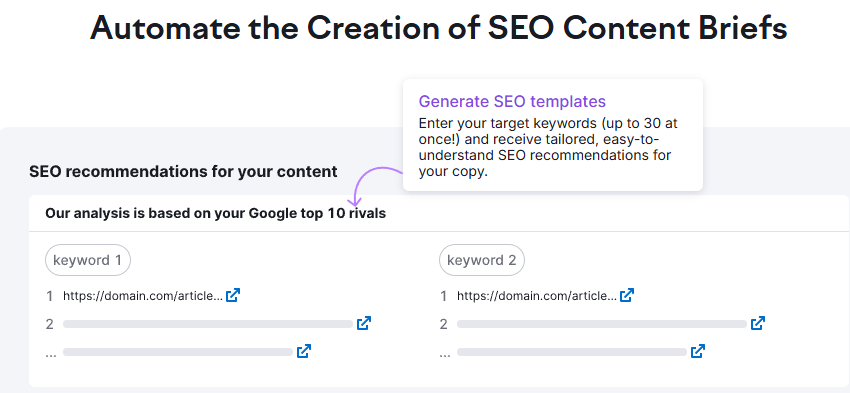
Technical SEO Made Easier Through Automation
Ah, once a daunting challenge, the back-end labyrinth of technical SEO is now made infinitely more manageable thanks to the wonders of AI-driven automation. With these tools in your arsenal, you’ll find that tasks such as improving site speed, configuring robots.txt files, and creating XML sitemaps turn complex puzzles into smooth, effortless processes.
Automation sweeps through your website like a gust of fresh wind, identifying and fixing broken links, optimizing your site’s architecture for crawling, and even adapting your site to the newest mobile-first indexing guidelines. No more endless nights scrutinizing site audits; your AI companions do the heavy lifting, allowing your team to focus on strategic and creative endeavours that require the human touch.
Crafting High-Quality Content Using AI
From Keywords to Context: AI for Enhanced Content Relevance
Diving from keywords to the rich sea of context can be a game-changer, and AI is the perfect diving instructor. Gone are the days when keyword stuffing could trick search engines into bumping up your rankings. Now, AI tools are sophisticated enough to understand the context surrounding your keywords, ensuring you hit the spot between relevance and readability.
When you feed the AI system with your desired keywords, they do not just nod in agreement but delve deeper, exploring related concepts, themes, and questions that your audience might be pondering. They suggest ways to expand your content’s scope gently, ensuring it stays resonant and authoritative. Content relevance is no longer just about what you say; it’s about painting a fuller picture that users – and algorithms – find irresistible.
Writing AI-Assisted SEO-Friendly Articles
As you brace yourself to craft that next SEO-friendly article, remember you have a silent but brilliant partner in AI. It’s like having a muse that inspires and brings a wealth of SEO knowledge to the table. Begin with a title and a few keywords, and watch as AI suggests outlines that will draw readers in and keep them hooked.
In the initial drafting phases, AI-powered writing assistants provide a jumpstart to overcome writer’s block and pull together cohesive, well-structured first drafts. As the piece progresses, the AI refines and polishes, ensuring the finished article is sprinkled with on-point SEO elements without compromising the natural flow and creativity of your writing. It’s SEO with a human touch facilitated by the precision of machines.
Streamlining Workflows with SEO Automation
The Effortless Approach to Bulk Optimization
Imagine effortlessly optimizing not just one but dozens of articles simultaneously – that’s bulk optimization redefined by AI. Whether it’s a suite of product descriptions or a series of blog posts, AI tools can now elevate vast content libraries to meet the ever-evolving SEO standards. And they do this with a finesse that doesn’t compromise the uniqueness of each piece.
The process is breathtakingly simple: you provide the text, and the AI sifts through, injecting related entities, optimizing for relevance, and aligning with search intent at a once-unimaginable scale. Imagine updating a content catalogue within minutes to reflect the latest keyword trends or algorithm updates. AI makes bulk optimization not just a possibility but a seamless and efficient reality.
Intelligent Internal Linking and Schema Generation
Intelligent internal linking is like weaving a spider’s web precisely – each thread is placed deliberately to guide visitors and search engines through your site’s various nooks and crannies. AI tools work marvellously by scanning your content and suggesting internal links that make sense not only contextually but also strategically funnel link equity to the pages that matter most.
Regarding schema generation, imagine waving a magic wand and turning the tedious task of writing code into mere child’s play. AI leaps into the spotlight, generating the complex lines of JSON-LD or Microdata code needed to create rich snippets – those shiny objects in search results that attract clicks like magnets. Whether for articles, products, events, or FAQs, your AI toolkit can conjure up precise schema markups in the blink of an eye, enhancing visibility and comprehension by search bots.
With AI, not only is the link network within your site strengthened, but the various types of content are also clearly marked for what they represent, shining a spotlight on them in the vast expanse of the web.
Best Practices for Incorporating AI into SEO
Balancing Human Expertise with AI Efficiency
The marriage of human expertise with AI efficiency is a match made in digital marketing heaven. AI may crunch numbers and spot patterns with uncanny speed. Still, it takes the intuitive touch of human experience to marry those insights with the emotional and psychological nuances of your brand’s story. It’s about striking a balance where AI handles the laborious, data-driven tasks, freeing you to interpret the nuances and craft strategies that resonate more deeply with your audience.
Humans also reign in AI, ensuring the content remains authentic and relatable. While AI can suggest a multitude of optimizations, it’s human judgment that decides what fits and what feels forced. It’s crucial to maintain this synergy – to allow AI to elevate the technical aspects of SEO while leveraging human creativity and strategic foresight to ensure those digital efforts truly connect with living, breathing beings.
The Future of AI SEO Tools
Predictions for SEO in 2025
As we peer into the crystal ball to discern the SEO landscape of 2025, one thing stands clear: the integration of AI into SEO practices is set to soar. Predictive analytics will likely take centre stage, with AI not only interpreting current data trends but also forecasting future search patterns and user behaviours. This will enable even more proactive content strategies, where you are on top of the game and three moves ahead.
Voice search could amplify its dominance as smart devices permeate every corner of life, making conversational AI and natural language processing even more crucial. The ability of AI tools to understand and optimize for voice search nuances will be indispensable. We might also see an increase in visual and video search capabilities, with AI fine-tuning content to be discoverable across various mediums – not just text.
In essence, SEO in 2025 seems poised for a landscape where AI partners become even more integral to the creative and optimization processes, steering strategies with a depth of insight that was once the stuff of science fiction.
Embracing AI-Powered Growth Opportunities
Embracing AI-powered tools for SEO is like strapping on a jetpack for your growth trajectory. As AI evolves, the tools at your disposal become ever more powerful, opening up opportunities for business development, brand visibility, and customer engagement. Leveraging AI’s data-crunching capabilities, you can capture new markets and understand your audience with a previously unattainable precision.
AI isn’t just about staying ahead; it’s about breaking new ground. With AI-driven insights, you can tailor your content with incredible specificity to diverse user segments, creating personalized experiences that build loyalty and drive conversions. You’ll witness the blossoming of new SEO strategies fortified by AI, sparking innovation and delivering tangible business outcomes.
Stepping into this AI-augmented era, the savvy SEO practitioner adapts and thrives, turning every byte of data into a stepping stone towards unprecedented growth.